Welcome to our ICE conference
An opportunity to IGNITE your research creativity and ingenuity, CONNECT with fellow researchers and ENGAGE in meaningful research discussions.

Monday 22nd and Tuesday 23rd June 2026
City Campus, University of Worcester
We look forward to welcoming Research students to present at our FREE two-day event held, in person, at the Severn Campus of the University of Worcester.
Under the theme of ICE – IGNITE.CONNECT.ENGAGE - the conference aims to bring together postgraduate researchers from all disciplines, stages of research, and backgrounds. This is a great opportunity for all postgraduate research students to present and discuss your research in front of a supportive audience and to develop and enhance your skills in sharing your work.
We invite postgraduate research students from all disciplines to submit an abstract for a range of presentation formats.
“Attending the PGR Conference was highly motivating, reinvigorating my drive to advance my project. It also provided a valuable opportunity to exchange ideas on a wide range of topics with both fellow students and staff.”
PGR Conference 2025 Attendee and Presenter
Full Conference Programme
Event Keynote
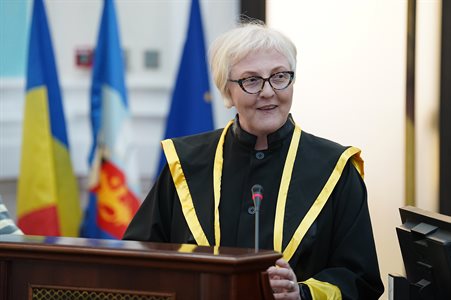
“The Unbearable Lightness of Being ... A Researcher”
Prof Nicoleta Cinpoes, Professor of Shakespeare Studies, Institute of Arts and Humanities
Cued by Milan Kundera’s novel The Unbearable Lightness of Being (1984), my talkunpacks the concepts of ‘weight’ and ‘lightness’ in relation to doctoral research.Interrogating their evaluation as positive and/or negative, I suggest that doctoralresearch is precisely in the business of shifting this assessment paradigm. While the two terms are ordinarily viewed as polar opposites, I suggest that they areinterchangeable; as a result, research emerges as a cyclical rather than a linear journey.To put it simply: how do you give an answer when you don’t even know what question to ask, and the language in which to articulate it has not yet been invented? In doing so, I am thinking – with the aid of maritime terms – about the compass a researcher constructs to navigate uncharted waters and manage strange encounters as much as about charting the course of research itself. I am interested in how such conceptsintertwine during the developmental ‘twin journey’ of the ‘doctoral research’ and the ‘doctoral researcher’ (Dely Lazarte Elliot 2022: 1659). Ultimately, I am proposing that, in the case of PhD research, as well as any research for that matter, the integration of process and product applies to both the research and the researcher.
Panels
Getting the most out of your conference experience
Want to get the most out of your PGR conference experience?
Join us for our panel session on Monday 22 June and find out more. We’ll be joined by three of our current doctoral students, Beas Banerjee, School of Science and the Environment, Heather Chapman, School of Health and Wellbeing, and Krista Easton, School of Health and Wellbeing, who will reflect on their experiences of attending and presenting at both internal and external conferences. They’ll also share how attending conference events has shaped their research as well as anything they wish they had done differently. We’ll wrap up the panel session by sharing some top tips for getting the most out of this year’s PGR Conference.
Workshops
Co-creating the researcher skills world
Throughout the conference, the Research Librarian and Academic Liaison Librarians invite delegates to co-create a researcher’s skills map, plotting where they are in the research skills world. If researchers find themselves in unchartered territory, on an open access oasis, or are all at sea with systematic reviews, the Librarians will be on-hand to set the coordinates for the Library support best-suited to help.
When the going gets tough...navigating the throwness of Doctoral study to flourish in your studies and beyond
Sarah Weaver, Dr Gilda Davis and Dr Emma Innes
This workshops aims to discuss health and wellbeing during the doctoral journey and as an Early Career researcher. Concepts of health, wellbeing, and resilience are personal and often experienced by individuals in multi-dimensional and subjective ways. Despite this, feelings of uncertainty, anxiety, ill-health and overwhelm may feel like common companions on our research journeys. Numerous studies highlight that doctoral candidates have higher reported rates of stress and mental health disorders than the background population. This peer-led workshop seeks to share stories from researchers about common challenges and experiences during their doctoral studies, and the actions that they took to overcome or manage them. Reference to the underpinning literature and recent evidence will be made. As part of the workshop, we will co-create an e-resource that encompasses a variety of multimedia activities and support networks, Apps or advice for researchers and students. By sharing and normalising conversations about the uncertainty and feelings that may occur in the world of academia and research, individuals may benefit from mutual support from their peers. Promoting health and wellbeing, and signposting tools and resources, may help researchers overcome common stressors as they navigate their doctoral/ECR journey.
Keeping the 'PH' in your PhD: why dismissing philosophy makes feedback hurt more than it should
Irene Conti, Dr Bere Mahoney and Dr Cate Rose
Feedback, critique and uncertainty are central characteristics of the PhD journey, but doctoral researchers often perceive these elements as intellectually challenging or even as criticism of their personal competence. This workshop introduces the idea that thinking like a philosopher is a tool for reframing how ones engage with feedback, critique and uncertainty because it provides a strategy for reinterpreting these central PhD characteristics as essential for their intellectual growth, and not as threats to their personal competence. This reframing tool uses the four pillars of philosophy - intellectual humility; foundational concepts; tolerance of uncertainty; and, reflection and distance, all foundations of the kind of thinking developed through doctoral study. The workshop explores how doctoral researchers can use this reframing tool to develop a constructive and reflective approach to feedback, critique and uncertainty, a capacity that is essential to all student doctoral journeys as apprentice researchers and beyond. Participants will also be encouraged to bring along an example from their own experience (for instance, a piece of feedback or a feedback experience that stayed with them) to support reflective discussion and practical engagement during the workshop.
NEW FOR 2026
PGR Writing Day:
Reflect on your time at the PGR Conference and join us for a writing day on Wednesday 24th June, 9:00-4:00pm. Choose PGR writing day as an add on during the booking process.
PGR Workshop Proposals:
Got a good idea for a workshop? At our 2026 conference, we invite you to submit a proposal for a 1-hour peer led workshop. The workshops can be on any topic. Your proposal should provide: a title, a description of the workshop, and the intended audience (e.g. early stage PGRs, middle stage, late, or all stage PGRs). We hope the sessions will be interactive and participatory, so please plan to include discussions and activities.
Please submit your proposal to research@worc.ac.uk
Available Streams
Presentations
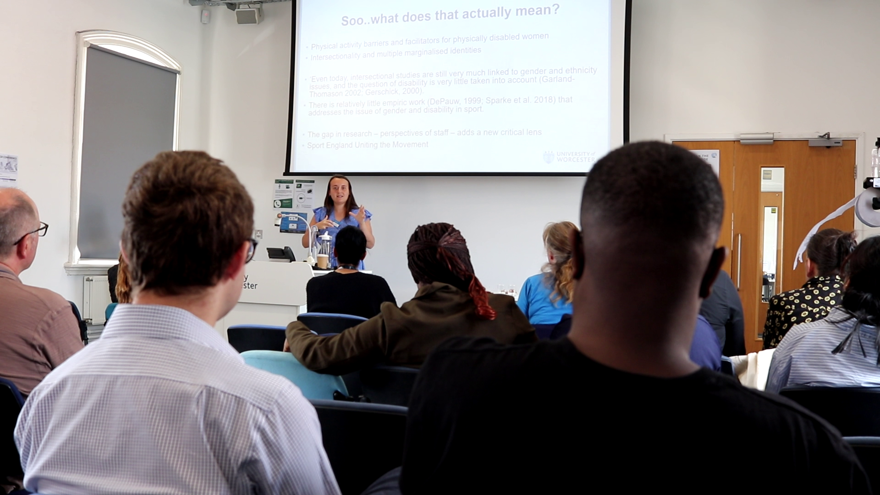
For mid to late stage PGRs: Presentations should be 15 minutes with up to 15 minutes for questions. Abstracts should be a maximum of 200 words and should include: context/aims of the research, methodology/approach, findings, and implications (research/practice as applicable). Presentations should not focus on an overview of your research project.
Ignite Presentations
For early stage PGRs, an opportunity to share your thinking to date, or a work in progress. If you are pre-data collection or at the design stage of your research and would like to present your work for early feedback, this could be the option for you. Abstracts for Ignite Presentations should be a maximum of 200 words and include the context/aims of your project and a brief insight into the intended purposes of your presentation. Each presenter will be given 5 minutes to present an aspect of their research, with 10 minutes for questions.
Book your Place
This is a free event but we ask all presenters and attending staff to book a place on the event.
Please book your place using the form below:
Submit your Abstract
Please ensure that your abstract has a title.
University of Worcester students - please upload your abstract on the link below:
2026 Postgraduate Research Conference - Abstract Submission
External students - please submit your abstract to research@worc.ac.uk.
Please submit your abstract in a PDF format.
Travel and Venue Details
This year we will be holding the conference at the university's Severn Campus situated by the River Severn and between the St John's Campus and the City Campus. Registration and welcome for both days will take place at Severn Campus's University Arena.
Details of the venue, including directions, maps and AccessAble guides, can be found on our Severn Campus webpage.
Accommodation
We are not able to offer university accommodation, however there are numerous options for accommodation in Worcester. You may find the following list of hotels useful for finding accommodation, with many more in the City and surrounding area:
Further information about Worcester is available at Visit Worcester.
PGR Conference 2025 Gallery
PGR Conference 2024 Gallery
PGR Conference 2023 Gallery