Sheila Scott... Who was she?
The Sheila Scott Building sits nestled in a corner of the University of Worcester’s St John’s Campus. A single story sandy coloured brick building with huge glass windows, it’s a light and busy place, home to the Clinical Skills and Simulation Centre.
Originally built as a school, it was acquired by the University of Worcester in September 2008, and was named after a famous aviatrix from the region.
But who was Sheila Scott, and why is she celebrated at the University of Worcester?
During the Second World War, Sheila Hopkins trained as a nurse and worked in a military hospital, caring for the wounded.
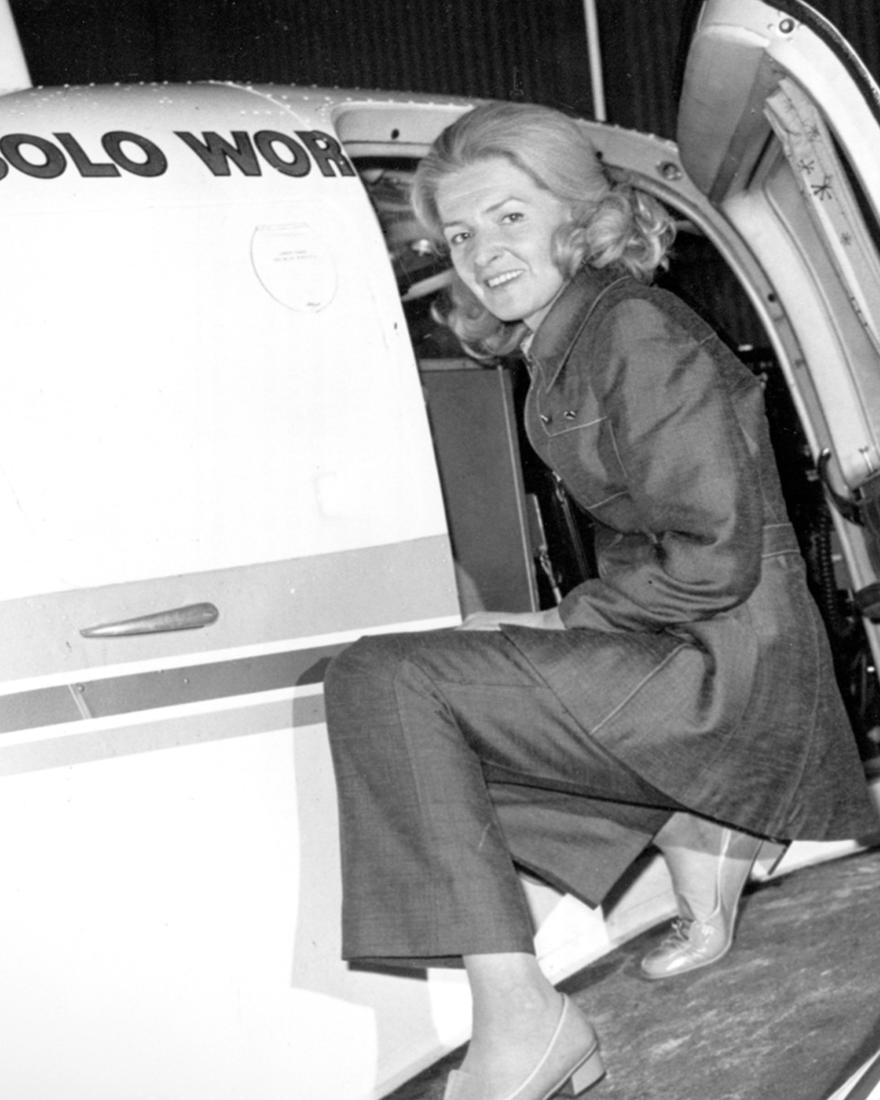 Sheila Scott
In 1943 she began a short career as an actress and adopted the name she would keep for life: Sheila Scott.
In the late 1950s, at the age of 37, she decided to learn to fly; a decision that would change her life. From the 1960s to the mid-1970s, she became one of Britain’s most accomplished aviators, setting more than 100 aviation records.
In 1966, Sheila became the first British person to fly solo around the world, completing the longest solo flight ever made at that time.
She also set records for solo flights over the North and South Atlantic, and in 1971 she became the first person to fly over the North Pole in a small aircraft.
Sheila became well-known in her flying career and often appeared in the media. She was awarded the OBE in 1968, and featured on programmes such as This is Your Life, and Desert Island Discs where she chose music by Gustav Holst and Tommy Dorsey, along with tobacco seeds as her luxury.
Despite her achievements, Sheila’s story has not always been widely recognised in her home city of Worcester. Staff at the University of Worcester and Worcestershire Archives recently held a public event to help share her story and celebrate her remarkable contribution to aviation.
It drew the attention of BBC Journalist Gavin Kermack, who has delved deeper into the remarkable story of Sheila through a fascinating and in-depth interview with Tom Mandall from the University of Worcester, and Jasmine Kee from Worcestershire Archives.