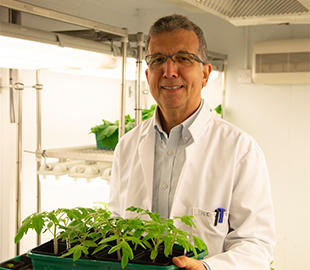
From a peasant farming background in Turkey to leading internationally recognised research at the University of Worcester, Professor Mahmut Tör has spent a lifetime asking the same question he first pondered as a boy: why do plants get sick - and how can we stop it?
Today, as global food insecurity worsens under the combined pressures of climate change, and emerging diseases, his work is not only answering that question, but also pioneering practical, sustainable solutions with the potential to transform how the world protects its crops.
Growing up on his family’s farm, a young Mahmut watched in frustration as certain fruit trees died while others, only metres away, flourished. That early mystery ignited a fascination that has driven decades of scientific inquiry and taken him from Turkey to the University of Worcester, where he now leads the Molecular Plant and Microbial Biosciences Research Unit, tackling one of the most urgent questions in modern agriculture - how do we protect crops without harming the planet?
His work is of the utmost urgency as, globally, 30-40% of crops are lost annually to pathogens and pests, with losses expected to worsen as temperatures rise and diseases spread into new regions. For legumes such as peas and beans, the oomycete pathogen downy mildew alone can destroy up to 75% of yields, threatening both nutritional security and farmer’s livelihoods.
For decades, crop protection has relied heavily on synthetic chemical pesticides. But as evidence of their environmental and health impacts has grown, the UK and EU have progressively restricted their use, leaving growers without reliable alternatives. At the same time, pathogens evolved resistance to many of the chemicals still in use. The need for safer, more targeted, and sustainable solutions, has never been greater.
Silencing disease at the molecular level
Downy mildew is among the world’s most destructive plant diseases, affecting peas, lettuce, grapevines and many other high-value crops. What makes it particularly difficult to study is that the pathogen cannot be grown in the laboratory independently of its host, making conventional genetic approaches impractical.
Professor Tör’s team developed an approach to work around this barrier, using double-stranded RNA (dsRNA) gene silencing to identify pathogen genes that are essential for infection, growth and reproduction. Building on this, the group went further: by applying small RNAs (sRNAs) directly to the leaves, they demonstrated that the pathogen could be suppressed without any genetic modification of the plant or pathogen. The technique, known as Spray-Induced Gene Silencing (SIGS), works by targeting and disabling specific pathogen genes, leaving other organisms unaffected.
This was one of the first successful applications of SIGS against an obligate biotrophic oomycete - a class of pathogens considered among the hardest to control - using nothing more than a biodegradable, sequence-specific spray. The approach offers a sharply targeted alternative to broad-spectrum chemical pesticides, with no lasting environmental residues.
Professor Tör's current research focuses on understanding how sRNAs function in plant-microbe interactions more broadly. Plants and their pathogens engage in a molecular dialogue and sRNAs appear to play a central role in how both sides regulate gene expression during infection. His group is working to map these sRNA-mediated communication pathways, with the goal of identifying new targets for disease intervention and new tools for crop protection.
Harnessing beneficial bacteria
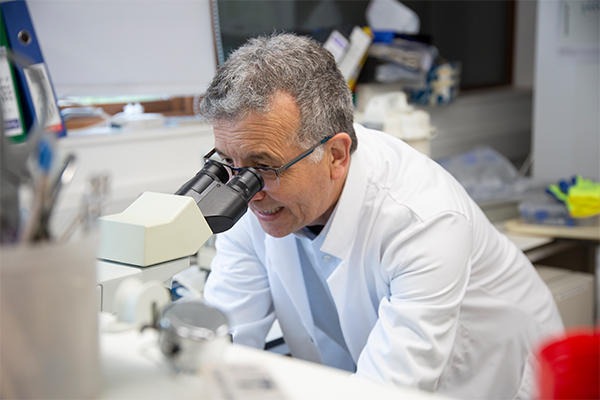
Alongside RNA-based strategies, Professor Tör’s group has explored the potential of naturally occurring soil bacteria as biocontrol agents. In research published in 2025, his team showed that specific strains of Bacillus and Pseudomonas - two groups of naturally occurring soil bacteria - could provide substantial protection against pea downy mildew under experimental conditions - offering a biologically grounded, chemical-free approach to disease management. This builds on earlier work demonstrating that Bacillus strains are also effective against other economically important soil-borne pathogens, including Fusarium - a fungal pathogen responsible for significant crop losses worldwide. Taken together, this body of work points to the broader potential of bacterial biocontrol agents across multiple host-pathogen systems. These findings are now being incorporated into crop improvement programmes through active collaborations with plant breeding companies.
Marker-assisted breeding for resilient crops
A parallel strand of Professor Tör’s work focuses on molecular marker technology. By identifying DNA markers associated with traits such as disease resistance and drought tolerance, plant breeders can select for desirable characteristics far more efficiently than through conventional crossing and observation. Research he led - in collaboration with academic and commercial partners - has used next-generation sequencing to develop validated molecular markers for resistance traits across a range of crops including pepper, tomato, and cucumber, and is working directly with commercial breeders to integrate these tools into active crop improvement pipelines.
Working in partnership
As climate change accelerates pathogen emergence, leading to new disease outbreaks, Professor Tör’s work is helping agriculture stay one step ahead. His research is conducted with teams in Turkey, China, the USA and across the UK. Together, these partnerships bring molecular, microbiological, genomic and ecological perspectives to bear on crop protection -generating tools and knowledge that are directly applicable to breeding programmes and agricultural policy. His research group at Worcester also trains the next generation of plant scientists, with students and postdoctoral researchers contributing to projects spanning gene mapping, effector biology, resistance mechanisms, and RNA-based crop protection. In doing so, they are supporting national and global policy ambitions.
These ambitions have taken on new urgency following the UK Government’s Global biodiversity loss, ecosystem collapse and national security report, which warns that threats to ecosystems, including plant disease, could undermine the UK’s food systems and strategic resilience. Research such as Professor Tör’s provides the scientific foundation needed to address those risks.
What began as a young boy’s curiosity has become a sustained scientific effort to understand and combat plant disease - one with practical consequences for farmers, food systems, and the environment.
Find out more about the School of Science and the Environment