The School of Law represented in first iteration of Model United Nations 'Universal Periodic Review'
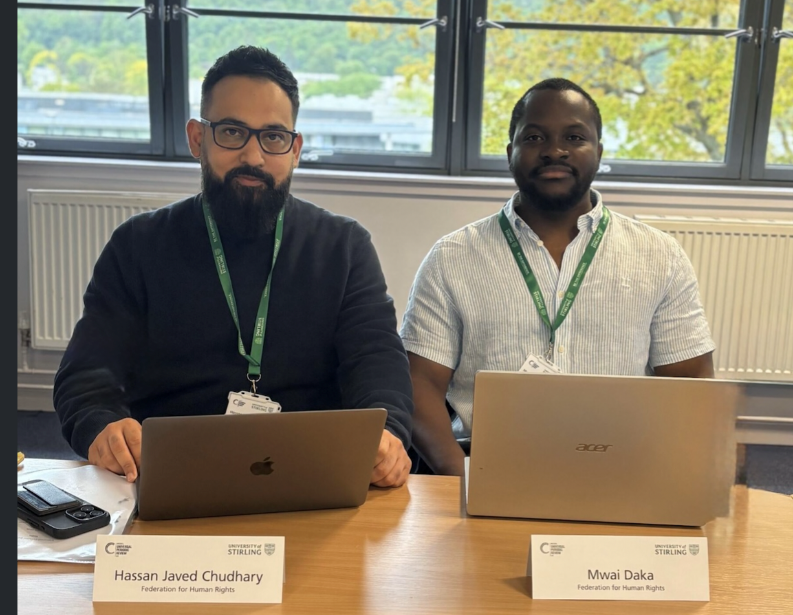
On May 21st – 22nd two University of Worcester PhD students, Mwai Daka and Hassan Chudhary, attended and engaged with the UK’s first Model Universal Periodic Review (UPR) hosted by the University of Stirling, Scotland. The trip was funded by the University of Worcester’s ‘Learning & Teaching Fund’.
The UPR is the United Nation’s (UN) way of reviewing countries’ human rights situations. Every four and a half years, a country has its UPR which is primarily undertaken by other countries hence it is often described as a process of peer-review.
Simulations are used frequently in legal education and are excellent at showing how the law operates in the real world. Model UNs, in particular, help students learn about the highly politicised environment in which international law operates.
Following the UPR’s establishment in 2006, model UPRs have been emerging. Notably the Padova Model UPR has run for eight years. The Model UPR held at Stirling, however, was the first of its kind in the UK. Funded by the Society of Legal Scholars and the Clark foundation for Legal Education, the initiative brought together students from different universities and from all levels of study.
Damian Etone, one of the convenors of the Model UPR, said
"The UPR reviews the human rights records of every country on earth. It seems only fitting that those who will one day contribute to that process, as lawyers, diplomats, civil society advocates, or academics, should have the opportunity to learn it by doing it. That is what the Model UPR UK is for. And if the energy in Stirling on those two days in May is any guide, it is an idea whose time has come.1
Hassan and Mwai played the role of representatives of the ‘Federation for Human Rights’. As a non-governmental organisation (NGO), their role was to inform UN member states as to the different human rights issues affecting the countries being reviewed. This required the submission of a written report and the giving of presentations."
Reflecting on the experience, Hassan said:
"The trip to Stirling in May was an important personal and academic experience for me as a PhD law student. Before attending, I knew very little about the UPR, which seemed distant and technical. Seeing the process in practice helped me understand it stage by stage, including the formal procedures and the less visible work behind them, such as preparation, research, report writing, engagement with delegations, and follow-up.
A particularly valuable part of the trip was learning how reports are prepared from both NGO and member state perspectives. Working on submissions individually and with my teammate, Mwai Daka, encouraged me to research human rights issues, cases, and reports in countries I had not previously studied. This collaboration strengthened my ability to divide tasks, give and receive feedback, and combine different strengths to produce clearer and more persuasive submissions. It also helped me see stronger links between my research interests and the practical impact of the UPR.
The experience also further developed my presentation, advocacy, and communication skills. Presenting arguments, justifying our reasoning, lobbying, and engaging in dialogue with delegations showed me the importance of preparation, clarity, and persuasion. I also improved practical skills such as note-taking, teamwork, and collaborative problem-solving.
More broadly, the trip gave me a more human understanding of global human rights issues and made the UPR feel connected to real people and struggles. I also valued meeting students from other universities and exchanging perspectives. I am grateful to the University of Worcester, Michael and Mwai for this opportunity."
Mwai said:
"The opportunity to travel to the University of Stirling in May for a workshop simulation on the UPR was invaluable to my doctoral research at the University of Worcester, which focuses on digital human rights and elections. It was equally relevant to my research Fellowship with the Southern African Institute for Policy and Research (SAIPAR) in Zambia, my primary case study country, as Zambia is due for its next UPR.
Prior to attending, I had limited practical exposure to the work of the UPR. The simulation significantly deepened my understanding of the mechanism, and the specific process NGOs follow when submitting evidence. Working alongside my colleague Hassan, I learned how to draft reports for consideration from an NGO’s perspective while gaining insight into the obligations of UN member states during a session.
Beyond the technical mechanics, the exercise strengthened my collaborative skills and challenged me to analyse human rights issues outside my typical geographical focus. While my research centres predominantly on African states, evaluating cases from regions like Asia broadened my analytical perspective.
Overall, the simulation provided vital insight into how the UPR holds states accountable for human rights violations. Connecting with scholars from other institutions also proved to be an excellent networking opportunity to share my doctoral work. I am deeply grateful to the University of Worcester, Michael Lane and Hassan for making this experience so rewarding."