On the eve of Halloween, people can delve into the dark legends and demonic folklore that gave rise to literature’s most iconic vampire at a special talk.
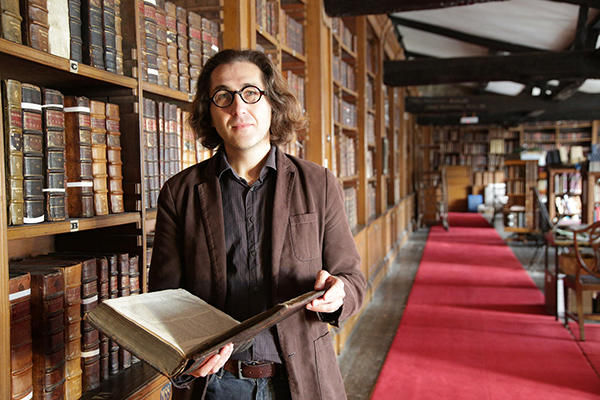 Professor Darren Oldridge
University of Worcester Professor of Early Modern History, Darren Oldridge, will be speaking on the novel Dracula, its central vampiric character’s appeal and its demonic origins at The Hive on October 30 (6.30pm-8pm).
Published in 1897, Bram Stoker’s gothic horror novel Dracula features vampire, Count Dracula, a Transylvanian nobleman who moves to England landing in Whitby, and the efforts to destroy him as he wreaks havoc there.
In this free talk, titled ‘Dracula and the Devil’, Professor Oldridge will reflect on the demonic origins of Stoker’s vampire and suggest that it is these attributes that help to explain his strange appeal. “In Count Dracula, Bram Stoker created an enduringly popular and thoroughly diabolical monster,” he said. “Among the many reasons why people enjoy Dracula and why it's endured so well is this diabolical aspect.”
Professor Oldridge said that the links between Dracula and demonism are numerous.
“Stoker explicitly relates Dracula to the Devil in several places,” he said. “He is also drawing on core texts on both vampires and also East European superstitions that were available in print in the later half of the 19th century.”
Professor Oldridge said one of the particular influences on Stoker as he was preparing the novel was a text by Emily Gerard published in 1885 called Transylvanian Superstitions, in which the Devil is significant.
“This Devil-soaked, superstitious culture that Stoker was interested in seeps into the novel,” he said. “There’s also a long tradition, stretching back centuries, of associating the returning dead with the Devil. Dracula is a revived corpse, and stories of the reanimated dead had existed in England and across Europe for generations. The most common explanation for such horrors was demonic possession of the dead.”
Professor Oldridge, a specialist in 16th and 17th century religious history, in particular witchcraft, the Devil and the supernatural, said that Bram Stoker’s work is distinct from other famous gothic novels of the time, such as Mary Shelley’s Frankenstein, or Robert Louis Stevenson’s Strange Case of Dr Jekyll and Mr Hyde.
“The monsters created in the 19th century or early 20th century are plentiful and enduring,” said Professor Oldridge. “Almost all of them belong in some way to what we might think of as the world of science. You've got Frankenstein's creature and Mr Hyde. You've got the aliens from H.G. Wells’ War of the Worlds, the dinosaurs from Sir Arthur Conan Doyle's The Lost World.”
He added: “All of these monsters are scientific or belong to science fiction. The big exception is Dracula, because Dracula is retreating to something much older. And the character is demonic. Dracula is explicitly diabolical in a way that most other great Victorian monsters aren’t.”
Tickets are free but booking is essential. To get a place visit: https://bookings.thehiveworcester.org/event/4575120.